
Maxi Jazz
Before stadiums and festival fields, Maxi Jazz was a South London record collector, soundsystem DJ and pirate-radio voice. Faithless gave him a worldwide stage, but the timing, discipline and calm authority were already there.
The voice came from the soundsystem
Maxi Jazz’s story makes more sense when it begins before Faithless: with records, Brixton, a soundsystem and the discipline of finding something new to play every week.
Maxwell Fraser grew up in South London and became Maxi Jazz long before the name appeared on arena bills. Hip-hop opened a door in the early 1980s, but it was the Soul Food Café soundsystem, started in 1984, that gave him a working education in selection, parties and the practical reality of building a crowd from the floor up.
Pirate radio came next. Maxi later remembered that radio changed the way he collected music: a party could survive on familiar favourites, but a weekly broadcast forced a DJ to keep digging. Reach FM, LWR and the wider London pirate network turned the record shop into part of the job. That background matters. When his voice later sat over huge electronic productions, it still carried the timing of somebody who understood records, rooms and DJs from the other side of the microphone.
Radio also nudged him towards making music. He built elaborate pause-mixed jingles for his own shows, then started making jingles and adverts for other presenters. That was an early production classroom hidden inside pirate radio: chopping tape, thinking about timing, building something memorable out of fragments and learning how a voice sits against rhythm before anybody was calling him a producer.
Faithless came together in 1995 around Rollo Armstrong, Sister Bliss and Maxi Jazz, and the chemistry was strange in exactly the right way. Rollo and Bliss could build records big enough for a field, while Maxi sounded like the calmest bloke in the room leaning over to tell you something worth hearing. No throwaway rave chants, no shouting for effect — just that measured voice sitting right in the middle of the pressure.
Insomnia became the breakthrough. Maxi later recalled being asked by Rollo to write words for the track, jotting down the lyric quickly and recording the vocal the following evening. The record eventually reached number three in the UK and became one of the defining dance singles of the decade. The famous sleepless-night narrative worked because it was specific, strange and human, not because it chased a club slogan.
That became the Faithless signature. God Is a DJ turned the club itself into a place of ritual and connection. We Come 1 took the idea of unity into a record that reached number three in 2001. Mass Destruction showed the same voice could address fear, conflict and politics without abandoning the dancefloor. Sister Bliss would later describe Maxi’s writing as a moral centre in the band.
His Buddhism was not an image pasted onto the music. Maxi spoke repeatedly about it as a practical influence on how he wrote, thought and behaved. Faithless gave him a vehicle for ideas about cause and effect, self-knowledge, peace and the relationship between people. That is why the records could work at three in the morning and still reveal another layer away from the club.
The scale became enormous. Official Charts records Faithless with seventeen UK Top 40 singles, seven Top 10 singles and three UK number-one albums. Yet Maxi’s stage presence never depended on behaving like a conventional rock star. He could stand almost still while an arena moved around him. The authority came from the voice, the words and the contrast between restraint and the size of the music.
A 1999 live review caught that control in the middle of a technical breakdown. With the system misbehaving, Maxi started rapping while the crowd clapped the pulse back at him; when the bass returned, the room was already with him. Any raver who has watched a night survive a dodgy PA knows the difference between somebody performing at a crowd and somebody who can actually hold one.
His work also reached outside Faithless. In 2002 he appeared with Robbie Williams on 1 Giant Leap’s My Culture, bringing his writing into a project built around musicians and ideas crossing borders. Later, after stepping away from Faithless touring, he formed Maxi Jazz & The E-Type Boys and moved deliberately toward guitar-led music — another reminder that his musical life was never confined to one successful formula.
Maxi Jazz died on 23 December 2022, aged 65. Faithless described him as a brilliant lyricist, DJ, Buddhist and magnificent stage presence. Those descriptions fit, but there is another part of the story: he was a bridge between London soundsystem culture, pirate radio, hip-hop phrasing and the scale electronic live music reached in the 1990s and 2000s.
For rave history, that bridge is the point. Maxi did not simply sing over dance records. He brought a DJ’s sense of space, an MC’s command of rhythm and a writer’s instinct for ideas into music built for some of the biggest rooms in the world.
Maxi Jazz on stage
Faithless • Manchester Arena • 4.12.10 • Andrew D. Hurley • CC BY-SA 2.0. Rock im Park • 5.6.15 • Stefan Brending • CC BY-SA 3.0.
 Faithless • Budapest Sports Arena • 21.3.11 • Sricsi • CC BY 3.0.
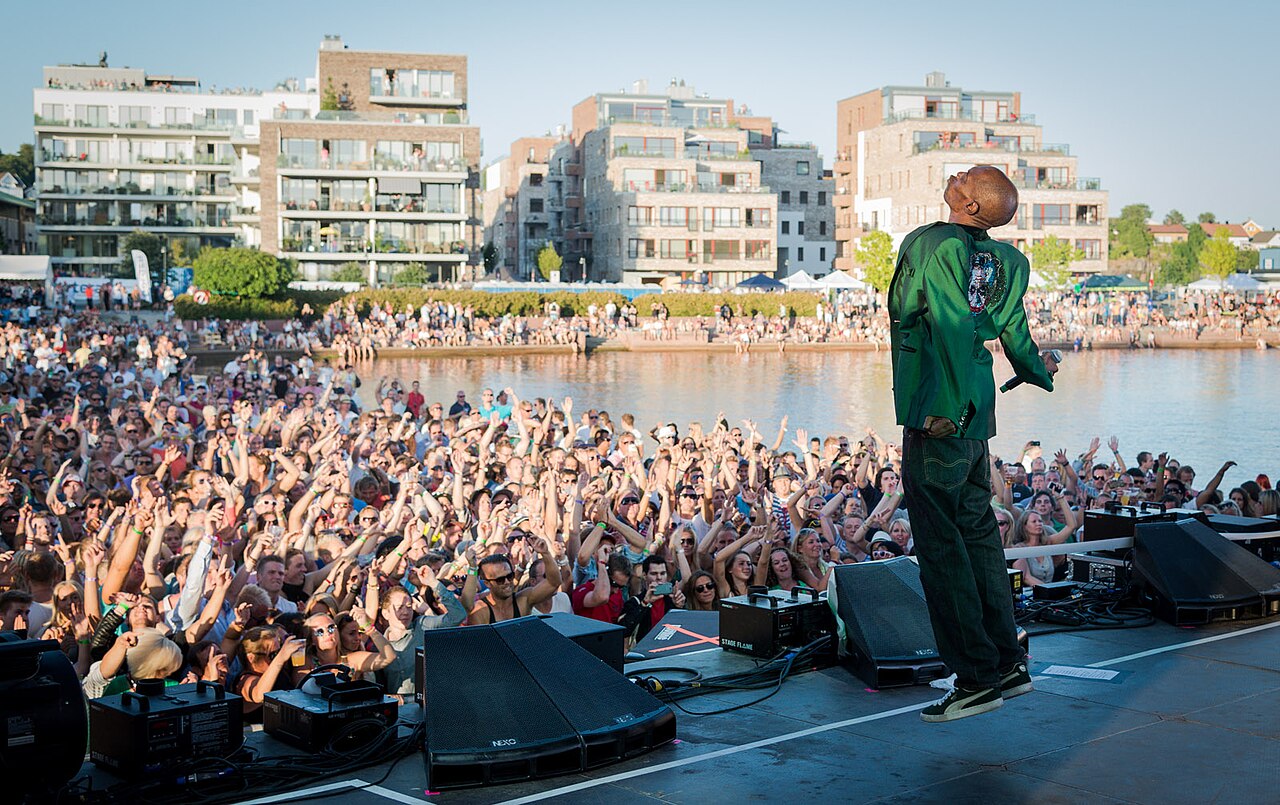 Faithless • Palmesus • 20.7.13 • Jørund Føreland Pedersen • CC BY-SA 3.0.
From South London to the world
Soundsystem & pirate radio
Soul Food Café and pirate radio built the selector’s discipline behind the later frontman: collect, listen, find something fresh and understand the room.
Faithless & Insomnia
A new electronic group finds its voice. Maxi’s writing turns sleeplessness into a record that crosses club culture into the national chart.
Ideas on a huge stage
God Is a DJ, We Come 1 and Mass Destruction prove that dance records can carry spirituality, politics and personal reflection without losing impact.
Beyond Faithless
Collaborations and the E-Type Boys show a musician still following curiosity rather than living permanently inside the sound that made him famous.
Faithless Sound System — Essential Mix
Rave Archive UK does not currently hold a Maxi/Faithless set of its own, so the next tier is this two-hour BBC Radio 1 Essential Mix from the Faithless Sound System.
Two hours from the Faithless world, with the club roots still intact beneath the arena-scale name.
The words inside the machinery
Four genuine moving-video pieces show the range of Maxi’s role: intimate writing, mass-audience connection and the control of a live stage.

The record that made Maxi’s restrained delivery unmistakable: a personal lyric over one of the era’s biggest electronic builds.

Faithless turns club culture into ritual: congregation, release and shared space expressed through Maxi’s words.

One of the clearest examples of Maxi’s recurring theme: connection over division, written for a room big enough to feel it together.

The live scale explains the second half of the story: a quietly delivered lyric commanding an entire arena without needing to shout.
Follow the wider story
A calm voice in enormous rooms
Dance music has always had voices that tell the crowd what to do. Maxi Jazz did something different. He gave people something to think about while the record was still working physically.
That ability came from several cultures meeting in one person: the London soundsystem, pirate radio, hip-hop, club music, Buddhism and the habits of a lifelong record collector. Faithless supplied the scale, but Maxi supplied the point of view.
That is why Insomnia survives beyond nostalgia and why lines from God Is a DJ, We Come 1 and Mass Destruction still feel attached to people rather than eras. His work understood that the dancefloor could be escape, congregation and argument at the same time.
More on Maxi Jazz
One voice. Thousands of rooms.
From a South London soundsystem to the biggest electronic stages in the world, Maxi Jazz never lost the sense that music was a conversation with the people standing in front of him.
Return to the Hall of Legends →