
Mark Bell / LFO
Leeds bass, skeletal bleeps and warehouse pressure turned into a Top 20 record — then the same restless producer carried that machine intelligence into Björk, Depeche Mode and far beyond rave.
When the bass became the main event
Mark Bell helped make one of those northern rave sounds you felt before you understood it. The bleeps were bare, the machines sounded cold, and then the bass hit hard enough to make the whole thing physical.
Mark Bell came out of West Yorkshire at exactly the right moment. House and techno were arriving from Chicago and Detroit, hip hop had already changed how young producers thought about machines and samples, and northern clubs were building their own relationship with bass. In Leeds, Bell and Gez Varley formed LFO in 1988. The name came from the low-frequency oscillator sitting inside the equipment, which was fitting: low frequency would become part of their identity.
Across Leeds and Sheffield, a regional sound was taking shape. Producers were stripping dance music down to bleeps, drum machines and huge sub-bass, mixing American electronic ideas with British sound-system thinking and warehouse pressure. When Warp Records began in Sheffield in 1989, that network finally had a label capable of putting its records into the wider rave world.
LFO became one of Warp’s defining early acts. Their self-titled track, usually remembered through the Leeds Warehouse Mix, was released as WAP5 in 1990. The bass was famously deeper than ordinary radios could really reproduce, yet the record still climbed to number 12 in the UK singles chart. A track designed to shake a warehouse had somehow gatecrashed the national chart.
That was part of the joke and part of the genius. On a little radio, half the record seemed to vanish. On a proper rave system, the missing information suddenly appeared in your chest. It taught a generation that the tune was not only what came out of the speaker — the system itself was part of the composition.
That success did not soften the music. If anything, it proved that the strange, stripped-back northern sound could reach a big audience without pretending to be pop. LFO’s early records helped give Yorkshire bleep a national identity and made Warp one of the labels people watched whenever a new piece of electronic machinery escaped into the world.
In November 1991 came Frequencies, Warp’s third album release. It took the rave-floor impact of the singles and stretched the idea into a full electronic world: LFO, We Are Back, Love Is The Message, Simon From Sydney and the rest showed that this music did not have to be treated as disposable twelve-inch culture. Rave-rooted machine music could work as an album and still sound dangerous through a big system.
LFO continued to change. Varley left the group in the mid-1990s and Bell carried the LFO name forward alone. Advance arrived in 1996; Sheath followed in 2003. The later records were less interested in repeating the first bleep formula and more interested in what machines could still do when pushed into stranger shapes.
At the same time Bell became increasingly important behind other artists’ records. His partnership with Björk became one of the great producer-artist relationships of 1990s electronic pop. He co-produced much of Homogenic in 1997, helping fuse brutal electronic rhythms with the album’s strings and volcanic emotional scale, and continued collaborating with her across later records and live work.
In 2001 he produced Depeche Mode’s Exciter. It was another useful reminder that Bell’s production identity was bigger than one recognisable LFO sound. He understood space, texture, rhythm and how to let electronic details carry weight without turning everything into noise.
Mark died on 8 October 2014, aged 43, following complications after an operation. Warp’s announcement brought together tributes from several worlds because his career had travelled through several of them: rave, techno, experimental electronics and major international records.
His place in the Hall comes back to the beginning. LFO showed that the North was not merely receiving dance music from somewhere else. Leeds and Sheffield were changing it, rebuilding it around their own clubs, machines and bass bins. Mark Bell was one of the people making that future audible.
A life through machines
LFO forms in Leeds
Mark Bell and Gez Varley begin working together as a new northern electronic scene gathers around clubs, studios and record shops.
LFO hits No.12
WAP5 turns sub-bass and bleeps into an unlikely national chart record without losing its warehouse identity.
Frequencies
LFO’s debut album proves rave-rooted electronics can hold together as a full-length world rather than a run of singles.
Advance
After Gez Varley’s departure, Bell takes LFO forward as a solo identity and refuses to simply remake the first album.
Homogenic
Bell becomes a key Björk collaborator, helping shape one of the decade’s landmark electronic albums.
Exciter
Depeche Mode put Bell in the producer’s chair for an album built around space, detail and controlled electronics.
Sheath
LFO returns with a harder, stranger record that shows Bell still had no interest in nostalgia.
Gone too soon
Mark dies aged 43, leaving a catalogue that joins rave history to experimental and international electronic music.
LFO — Leeds Warehouse Mix
Sub-bass becomes the headline.
LFO was a club record that behaved like a physical object. The bleeps were skeletal; the bass did the heavy lifting. Released by Warp in 1990 as WAP5, it reached UK No.12 even though much of its low end disappeared through ordinary radio speakers. On a proper system, of course, that was the whole point.
Yorkshire bleep goes nationwide
LFO belongs inside the wider story of Sheffield, Leeds and the first Warp catalogue.
Warp’s earliest records documented bleep assembling in real time: Forgemasters, Nightmares On Wax, Sweet Exorcist and LFO all approached machines and bass from slightly different directions. The label did not invent the northern scene, but it gave the scene catalogue numbers and a route out into the wider country.
By the time Frequencies landed in 1991, LFO had helped move Warp from an exciting regional dance label towards the album culture that would later define it internationally.
Frequencies still sounds like a record made with the rave in mind but without being trapped by it. The beats hit, the bass moves air and the arrangements leave enough space for the machines themselves to have character.
It is also a bridge: early Warp bleep on one side, the label’s increasingly adventurous album years on the other.
Björk, Depeche Mode and the producer’s ear
Bell’s later production work makes more sense when heard as an extension of LFO rather than a separate career. He was always interested in what happened when familiar musical material was put under unusual electronic pressure.
With Björk, especially on Homogenic, that instinct met an artist who wanted beats to feel geological. Bell’s programming and production helped turn strings, voice and distorted electronics into one coherent landscape. The relationship continued well beyond one album.
Producing Depeche Mode’s Exciter showed another side: restraint. Instead of forcing LFO’s low-frequency signature onto the band, Bell used detailed rhythm, negative space and texture to serve the songs. That ability to disappear into the job is part of why musicians trusted him.
Mark Bell and LFO
Live hardware, portraits and LFO-era images sit beside the records here because Bell’s story was always as much about machines in rooms as names on sleeves.
Mark Bell performing live with LFO hardware. Mark Bell.
 Mark Bell in the studio.
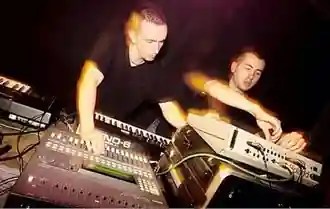 LFO hardware in action.
 Mark Bell and Gez Varley — LFO.
Mark Bell remembered in the mix
Listen stays audio-only. Carl Cox’s tribute moves from LFO into Bell’s wider production world and keeps the focus on the sound rather than the résumé.

A long-form tribute reaching from LFO into the records and productions that carried Bell’s influence far beyond bleep.
LFO on screen
The official video for the record that put Leeds bass pressure into the national chart without cleaning it up for anybody.

The Leeds Warehouse sound in moving pictures: skeletal bleeps, ridiculous sub-bass and a tune that somehow reached No.12.
Follow the low-frequency trail
The North was producing the future
Mark Bell matters to rave history because LFO makes a simple point impossible to miss: British dance music was not one sound radiating out from London. Yorkshire was a production centre in its own right, taking house, techno, hip hop and sound-system bass and rebuilding them into something local.
The influence runs forward through techno, hardcore and the British obsession with sub-bass that later turns up in jungle, garage, grime and dubstep. Not because every producer copied LFO, but because records like LFO proved how much identity could live in the bottom octave.
Bell then carried the same adventurous instinct into records heard far beyond rave. That makes the story unusually complete: warehouse bass, Warp albums, Björk, Depeche Mode — all joined by a producer who kept asking what the machines could do next.
More on Mark Bell and LFO
Low frequency, long shadow.
Mark Bell helped make bass into a northern electronic language, then spent the rest of his career refusing to stand still inside it.
Back to the Hall of Legends →