Caspar Pound
From Total Confusion and The Hypnotist to Rising High, Caspar Pound kept pushing rave music past the obvious next move — from hardcore pressure into techno, trance, ambient and whatever else made sense. 1970 — 30 April 2004.
The label was as important as the records
Caspar Pound had the tunes, but the bigger story is what he built around them. Rising High became one of those labels that made ravers look beyond the obvious pile and hear how much wider electronic music could go.
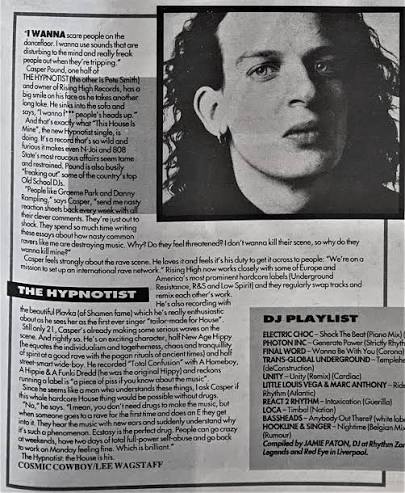
Caspar Pound was frighteningly young when he started leaving his fingerprints on British dance music. Before Rising High became a label you learned to trust on sight, before The Hypnotist was tearing through rave sets, he was already part of A Homeboy, A Hippie & A Funki Dredd. Total Confusion hit the UK chart in 1990, but the important bit for ravers is the sound of it — house, techno, hip-hop sampling and that harder British energy all colliding before anyone had fully agreed what to call the next thing.
John Peel was hearing that movement too. He played A Homeboy, A Hippie & A Funki Dredd in 1990 and invited the group to record a BBC session. Recorded on 13 January 1991 and first broadcast on 3 February, it put Pound’s work inside the national-radio story just before Rising High opened its doors.
Then came Rising High. Caspar founded the label in London in February 1991, and with Pete Smith as The Hypnotist he launched it with Rainbows in the Sky / Death by Dub. For a lot of ravers, that early Rising High sound had its own feel straight away: fast, psychedelic, slightly unhinged and never too bothered about whether it belonged under house, techno or the harder edge of the UK rave sound. If it worked at volume, it belonged.
The Hypnotist quickly became the name ravers knew. Rainbows in the Sky, The House Is Mine, Hardcore You Know The Score — these were not polite records. They had that early-90s rush of machines pushed hard, big samples and enough theatre to make them instantly recognisable in a set. Britain got them, Germany really got them, and Caspar’s harder European edge fitted perfectly into the moment when rave was getting faster, darker and more adventurous by the month.
What really lifts Caspar’s story above a run of great old-skool tunes is what he did next. Rising High could easily have spent years cloning its first successes. Instead the record box got wider. Hardcore techno sat beside ambient music, abstract electronics and records made for the hours after the main room had emptied. Mixmaster Morris, Pete Namlook, Bedouin Ascent, Earth Leakage Trip and others made the label feel less like one sound and more like somebody handing ravers a map and saying, “there’s more out there — go and listen.”
That open outlook became infrastructure. Harthouse’s own history confirms that its UK arm was distributed through Rising High from 1992 until 1994. At the exact moment Frankfurt’s harder trance and techno sound was becoming influential in British record boxes, Pound’s operation supplied a formal route into the UK rather than relying only on scattered imports.
Rising High also looked west. Its licensing relationship with Underground Resistance connected the label to Detroit’s independent-techno tradition. London rave, Frankfurt techno, Detroit futurism and the ambient room could all meet under the same company. That is one of the clearest reasons Pound matters historically: he helped British rave hear itself as part of a wider electronic culture.
His own work kept moving as well. Rising High Collective, New London School of Electronics, remixes and related projects pulled him through techno and trance beyond the first Hypnotist period. Fever Called Love remains closely associated with Pound and the Rising High world, while its earliest release trail belongs to R&S / Outer Rhythm — a catalogue detail worth keeping straight.
His reputation remained particularly strong in Germany, and a surviving recording from Tresor in Berlin on 27 December 2003 catches Pound — The Hypnotist — still performing only months before his death.
Caspar Pound died on 30 April 2004, aged 33. He left a catalogue far larger than one alias and a label whose influence came from refusing to choose between the rave floor, the techno room and the chill-out space.
That is why Caspar belongs here. The Hypnotist records alone are woven into the sound of early-90s rave, but Rising High gave him an even bigger legacy. He did not just make tunes for ravers — he helped widen what ravers might hear next. Hardcore, techno, trance, Detroit electronics, ambient: once Caspar opened the door, plenty of us followed.
Caspar Pound in frame
 Caspar Pound.
 Caspar Pound.
 Caspar Pound.
More than The Hypnotist
The production trail shows how widely Pound worked: artist projects, label productions and remixes that reached well beyond the first Rising High hardcore records.
Total Confusion
A Homeboy, A Hippie & A Funki Dredd put Pound into the first wave of British electronic records crossing from the underground into the national chart.
Official Charts ↗The Hypnotist
With Pete Smith, Pound launched Rising High’s own recording identity through Rainbows in the Sky, followed by The House Is Mine and Hardcore You Know The Score.
Rising High history →Union Jack — Two Full Moons & A Trout
The Rising High edition carried a dedicated Caspar Pound mix. Union Jack’s current Bandcamp release still credits the 12-minute Caspar Pound Remix directly.
Union Jack ↗Fever Called Love
Pound’s work with Plavka pushed the Rising High story into vocal trance and later remix culture; the project remained active in the catalogue well beyond the early hardcore phase.
Dance chart ↗Some Remixes 91–94
Rising High itself collected Pound’s production and remix work across M-Age, New London School of Electronics, OBX, Rising High Collective, Phobia, Plavka and Union Jack.
Discography ↗Beyond the label
Contemporary retrospectives also document Pound remixing Sven Väth’s My Name Is Barbarella and The Shamen’s Pro-Gen, showing how his studio work travelled across techno, trance and chart-facing dance music.
909originals ↗A career moving faster than genre names
Total Confusion
A young Pound reaches the national chart while British dance music is still inventing the vocabulary that will become rave.
The Hypnotist & Rising High
RSN1 opens a catalogue that begins with hardcore rave pressure but refuses to stay confined to one sound.
Frankfurt, Detroit, London
Harthouse UK distribution and Detroit licensing turn Rising High into an international route as well as a British label.
Hardcore to ambient
Techno, trance, experimental electronics and chill-out music sit beside the rave records as the label’s identity broadens.
Hear Caspar and the Rising High world
These surviving audio recordings cover a late Caspar performance, the wider Rising High catalogue and a dedicated remembrance programme.
A late surviving recording from Back To Basics VIII at Tresor, with Pound represented as The Hypnotist.
A long catalogue journey through Caspar remixes, The Hypnotist, New London School of Electronics and the wider Rising High orbit.
A dedicated radio programme tracing Pound’s music and the breadth of the Rising High catalogue.
The Hypnotist on screen
Watch is kept for real moving footage. The surviving music-video route below is used as video, not as a substitute audio upload.
The Radio Edit music video for one of Caspar Pound and Pete Smith’s defining first-wave Rising High records.
Rising High in the actual rave boxes
These aren’t Caspar performances. They show Rising High records circulating inside major UK rave and club sets during the period.


The track information includes Rising High Collective, placing Pound’s wider project inside the progressive-club side of the early-90s scene.
 DJ Seduction — Dreamscape 2 — 28.2.92
The tape lists Project One — Roughneck, catalogue RSN22 on Rising High, putting the label inside a major Sanctuary rave set.
 Carl Cox — Dreamscape 3 — 10.4.92
The tracklist includes Interface — The Toytown EP on Rising High, another label record caught in the working rave circuit.
Follow the connections
He widened the record box
Caspar Pound had more than enough records to earn his place on the rave side alone — Total Confusion, Rainbows in the Sky, The House Is Mine and Hardcore You Know The Score still sound like the early ’90s throwing sparks.
But Rising High is the reason his story gets bigger. The label put hardcore techno, Frankfurt trance, Detroit electronics, ambient and stranger listening records into the same orbit, and British ravers followed those routes because the records were there in front of them.
That was Pound’s real strength: he did not treat the rave floor like a closed world. He kept opening doors out of it — and bringing new sounds back in.
More on Caspar Pound
Rising high, looking outward.
Some people left a run of records. Caspar Pound also left a route through the music — from British rave to Frankfurt, Detroit and the ambient room beyond the main floor.
Return to the Hall of Legends →