
Kemistry
A foundational selector, organiser and co-founder whose work with Storm and Goldie helped turn a loose network of hardcore experimenters into Metalheadz — one of drum & bass’s defining institutions.
More than one half of a DJ duo
Kemistry’s story is about friendship, organisation, taste and the labour required to turn an underground scene into something durable.
Valerie Olukemi Olusanya — Kemi to friends, Kemistry on flyers — was born in Birmingham on 13 October 1963 and grew up in Kettering in the Midlands. She met Jayne Conneely, later DJ Storm, before either woman imagined a life in drum & bass. Their friendship was built around music first: new wave, synth-pop, industrial records and the growing excitement of the early rave years.
When they reconnected in London around the end of the 1980s, the city was changing quickly. Thursdays at Rage at Heaven exposed them to Fabio and Grooverider’s increasingly breakbeat-driven sets; trips to hear Doc Scott and nights in warehouses widened the picture. They did not approach jungle as outsiders looking for a niche. They were committed ravers who wanted to understand what the music was becoming.
Kemistry’s relationship with Goldie became another crucial thread. She took him to Rage and helped pull him into the new hardcore culture. As Goldie’s ambition for a label developed, Kemistry and Storm became part of the practical foundation around it. Metalheadz did not emerge from one person’s vision alone: the label’s early life depended on the taste, contacts and relentless work of the people around it.
Kemistry and Storm learned to DJ together and moved onto pirate radio, including Touchdown FM and Defection FM. At first they were careful about how promoters would respond to two women in a male-dominated scene. Storm later recalled taking booking calls as though she were managing the pair because callers did not realise the DJs on the tape were women. Once behind the decks, that distinction mattered less than their selection and control.
The partnership was distinctive because their sets could be hard, atmospheric and deeply musical without becoming predictable. They documented what they bought, built mixtapes carefully and treated DJing as a serious craft. Their rise coincided with drum & bass moving away from rave’s stylistic free-for-all into a more defined culture, and they helped ensure that deeper, more experimental music had advocates at the centre of it.
Metalheadz launched in 1994. Kemistry and Storm were not decorative names on the masthead. They helped run the label, recruit artists, handle press and promotion and represent the imprint. When the Sunday Sessions began at the Blue Note, the club became one of the most important laboratories in 1990s drum & bass. Producers brought fresh dubplates, DJs took risks and records could be tested against a demanding room almost immediately after leaving the studio.
The pair toured internationally and became role models without asking to be reduced to that function. Their DJ-Kicks mix, released shortly before Kemistry’s death, remains one of the clearest documents of their shared musical logic: rolling, dark, spacious and exact.
On 25 April 1999, while returning from a gig with Storm, a metal road stud dislodged by another vehicle passed through the windscreen and struck Kemistry. She was killed in the accident, aged 35. The suddenness of her death froze a partnership that had only begun to show how far it could travel.
Her legacy sits inside Metalheadz itself, but also inside a broader change in who could occupy authority in drum & bass. Kemistry was not significant because she was a woman in a male scene; she was significant because she was one of the people making decisions about what the scene could become.
Building a scene from inside it
Ravers first
Rage, Doc Scott and warehouse culture provide the musical education that leads to the decks.
Pirate radio
Kemistry & Storm develop a shared sound and prove themselves through tapes, broadcasts and bookings.
Metalheadz
The label and Blue Note residency become central institutions in experimental drum & bass.
DJ-Kicks
The acclaimed mix captures the partnership shortly before Kemistry’s life is cut short.
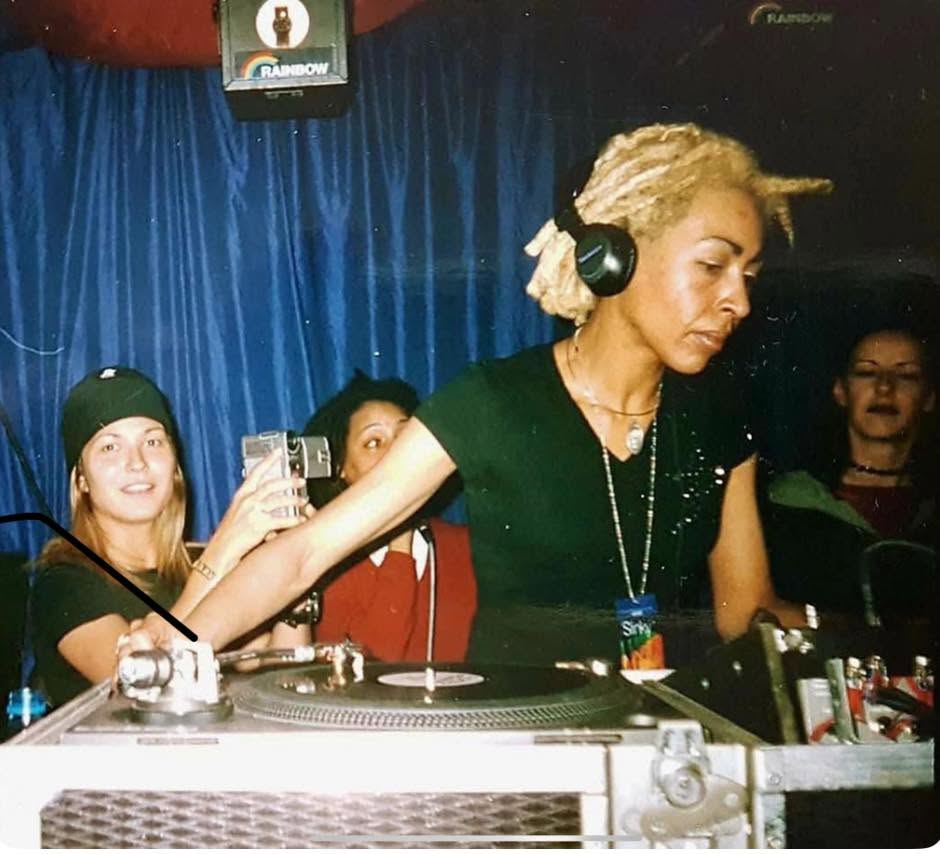
Kemistry in frame
The photographs also catch the wider circle around her, because Metalheadz was built through relationships as much as releases.


The partnership on tape
These surviving sets show Kemistry and Storm in the environment where their reputation was built.


The institution behind the iconography
Metalheadz has become a symbol of 1990s drum & bass sophistication, but symbols can hide labour. Kemistry’s importance lies partly in making the institution function: the calls, tapes, artists, press, bookings and judgement that allowed a label and club night to become a culture.
Her partnership with Storm also changed expectations. They did not adopt a novelty position as “female DJs”; they insisted on being judged as selectors and then became internationally respected because of the quality of the work.
Twenty-five years later, younger DJs can enter drum & bass and see women occupying every level of the scene. That progress has many causes, but Kemistry belongs in its foundation.
Keep the connection
More on Kemistry
More than a resident. More than a name on a label.
Kemistry helped create the conditions in which a whole strand of drum & bass could grow.
Return to the Hall of Legends →Listen to Kemistry & Storm
Six recordings follow Kemistry & Storm from early promotional tapes and pirate radio into Telepathy and the Blue Note, showing the partnership in its own sound.
Talkin’ Headz — The Metalheadz Documentary
The 1998 Metalheadz film puts Kemistry right inside the label, the Blue Note nights and the people who made that era what it was.

A period look at Kemistry, Metalheadz and the Blue Note era.
